-
- The Doctrine of Being.
- Quality
- Quantity
- Pure Quantity;
- Magnitude (Quantum);
- Degree.
- Measure
- The Doctrine of Essence.
- The Doctrine of the Notion.
- The Subjective Notion;
- The Object.
- The Idea.
- The Doctrine of Being.
It is stikingly evident that Hegel some-
times passes from the abstract to the con-
crete (Sein[1] (abstract)—Dasein[2] (con-
crete)—Fürsichsein[3]) and sometimes the
other way round (the Subjective Notion—
the Object—Truth (the Absolute Idea)).
Is not this inconsistency of an ideal-
ist (what Marx called the “Ideenmystik”[4]
in Hegel?) Or are there deeper reasons?
(e.g., Being = Nothing—the idea of Be-
coming, of development). First of all im-
pressions flash by, then Something emerges,
—afterwards the concepts of quality #
(the determination of the thing or the phe-
nomenon) and quantity are developed. After
that study and reflection direct thought to
pressions flash by, then Something emerges,
—afterwards the concepts of quality #
(the determination of the thing or the phe-
nomenon) and quantity are developed. After
that study and reflection direct thought to
“Sein” only
as a mo-
ment in
πάντα ρεϊ[5]
cognition of identity—of difference—of
Ground—of the Essence versus the Pheno-
menon—of causality, etc. All these mo-
ments (steps, stages, processes) of cognition
move in the direction from the subject
to the object, being tested in practice and
arriving through this test at truth (= the
Absolute Idea).
Ground—of the Essence versus the Pheno-
menon—of causality, etc. All these mo-
ments (steps, stages, processes) of cognition
move in the direction from the subject
to the object, being tested in practice and
arriving through this test at truth (= the
Absolute Idea).
# Quality and sensation (Empfindung)
are one and the same, says Feuerbach. The
very first and most familiar to us is sen-
sation, and in it these is inevitably also
quality....
are one and the same, says Feuerbach. The
very first and most familiar to us is sen-
sation, and in it these is inevitably also
quality....
If Marx did not leave behind him a
“Logic” (with a capital letter), he did leave
the logic of Capital, and this ought to be
utilised to the full in this question. In
Capital, Marx applied to a single science
logic, dialectics and the theory of knowl-
edge of materialism [three words are not
needed: it is one and the same thing]
which has taken everything valuable in
Hegel and developed it further.
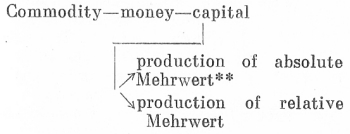
The beginning—the most simple, ordi-
nary, mass, immediate “Being”: the single
commodity (“Sein” in political economy).
The analysis of it as a social relation.
A double analysis, deductive and inductive
—logical and historical (forms of value).
nary, mass, immediate “Being”: the single
commodity (“Sein” in political economy).
The analysis of it as a social relation.
A double analysis, deductive and inductive
—logical and historical (forms of value).
|
Testing by facts or by practice respec-
tively, is to be found here in each step of the analysis. |